A Brief Shotokai History (Part I)
It is actually a very long, fascinating and complex history, but we will try to give a short concise summary in the following section:
- Gichin Funakoshi (1868-1957; considered the father of Karate-do) studies Karate with Yasutsune Azato, one, if not the greatest and most important Okinawan masters of Karate and also with another great Yasutsune Itosu (he also studied with Sokon Matsumura).
- In 1922, due to his extensive knowledge, culture and technical level, he is invited to participate in an exhibition on the Japanese mainland islands in Tokyo. He is then asked to stay by many important people. He thus establishes himself there and will never return to Okinawa.
- In Tokyo, after a very tough start, he begins Karate’s expansion. This was strongly impulsed by the establishment of University Karate Clubs, a characteristic it holds until this very day.
- In 1935, Shotokai is informally organized (Shoto’s Association, Shoto being O-sensei’s pseudonym) to collect funds to build a Hombu Dojo (headquarter training hall) for the Master.
- In 1936 he establishes formally the name “Karate-do” as the name of his art. After this, the same year, all the Okinawan masters get together and accept this new designation.

A Brief Shotokai History (Part II)
-
In 1936 the Shotokan Dojo is inaugurated, headquarters for Master Gichin Funakoshi’s Karate-do.
-
In 1949 Isao Obata establishes the Nihon Karate Kyokai, as a means to help Master Funakoshi in the development of Karate-do. Even though initially the idea was that the association should include all groups, this did not occur. Neither did all of Gichin Funakoshi’s students become part of it, for example Shigeru Egami and Genshin Hironishi.
-
By the end of the 40’s and the beginning of the 50’s strong friction arises within the NKK due to the commercialization of Karate-do. The great masters cut links with the NKK, that finally ends up in the hands of the Takushoku University.
-
In 1951 Shotokai reunites, and the association formalizes its existence as an association in 1956. Founders: Gichin Funakoshi, Shigeru Egami and Genshin Hironishi. Objective: to preserve the true Karate-do, without considering it a sport.
-
April 1957: Master Gichin Funakoshi dies. Shotokai organizes the funeral (the NKK does not assist). Gichin Funakoshi’s family delivers the legacy of O-sensei’s documents, the Shotokan and Shotokai names and his symbol (the tiger) to Shotokai, as were his wishes.
-
Shigeru Egami & Genshin Hironishi share the responsibility of directing Shotokai.
-
In 1981, Master Shigeru Egami dies. Genshin Hironishi continues to direct Shotokai together with his older students.

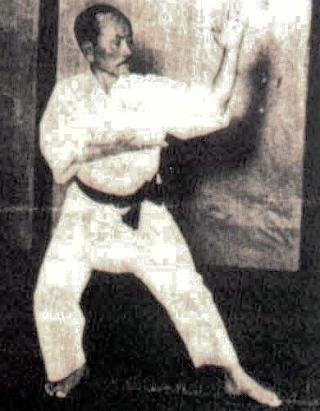
Sensei Gichin Funakoshi – Father of Modern Day Karate
“Karate-do is a noble martial art, and one can rest assured that those who take pride in breaking boards or smashing tiles, or who boast of being able to perform outlandish feats, really know nothing about karate. They are playing around in the leaves and branches of a great tree, without the slightest concept of trunk” – Gichin Funakoshi
Sensei Gichin Funakoshi is known as the Father of Modern Day Karate and is probably the best known name in karate history.
He was born in the city of Shuri on the island of Okinawa in 1868 and by the age of 11, Funakoshi was training with the great Okinawan teachers Anko Itosu and Yasutsune Azato.
At this time it was illegal to learn martial arts, though that did not stop him and many others practicing in secret. Around the turn of the century the art came out into the open and began to be taught in public schools, thanks largely to the efforts of Anko Itosu.
Sensei Gichin Funakoshi and Japan
By the time Funakoshi was an adult he excelled in karate, so much so that when the Crown Prince of Japan, Hirohito, visited Okinawa, Funakoshi was chosen to performed a demonstration for him.
When the Japanese Ministry of Education held a demonstration of karate in Tokyo a year later in 1922, the Okinawan Department of Education who he worked for as a school teacher asked him to be the one to perform it and introduce the art to Japan; when he did, a new era in the history of the martial arts was born.
The Japanese were so impressed that he was asked to stay in the country to further demonstrate and teach his art. This began with an invitation from Jigoro Kano, the founder of Judo, who asked Funakoshi to demonstrate karate in front of over one hundred of his students.
After this, the requests kept coming so Master Funakoshi decided to move to Japan permanently. He quickly gained students in the universities in and around Tokyo and soon he had enough interest to start his own dojo.
Sensei Gichin Funakoshi’s Development of Karate
Sensei Gichin Funakoshi earned the title the Father of Modern Day Karate in a number of ways. One was that he adapted the training methods so that they could be more easily practiced by everybody, regardless of age, ability or sex.
He also made karate more accessible to the Japanese by changing the meaning of the word ‘Kara’. Originally the meaning used was ‘Chinese’ with ‘Te’ meaning ‘hand’ but the characters used for Kara could also mean ‘empty’ in Japanese.
As this fitted the style so well and because karate had developed to be very different from the Chinese styles, it became the new meaning of the word. He also changed the name of many of the kata, again making them more acceptable to a Japanese culture that hated everything that was Chinese.
Amongst his more prominent beliefs was Funakoshi’s conviction that the best martial arts exponents should be so confident that they had nothing to prove about their fighting prowess. The true art was found in subduing an opponent without fighting, echoing the teachings of the legendary samurai Tsukahara Bokuden from over 400 years previously.
Sources:
http://www.historyoffighting.com/sensei-gichin-funakoshi.php
 Hidgi Chuan